

Story By: Marion Apio – Media Challenge Initiative Fellow, Class 2020.
With a wealth of fertile farmland that could feed its entire population of 39 million people and over 1.3 million refugees, Uganda still faces hunger that is on the rise and farmers are still facing the daily challenge of firefighting food loss.
According to the World Food Programme (WFP), 40 percent of the crops harvested in the country are lost to disease, pests, rot — all caused by poor post-harvest handling and storage. That means hunger, malnutrition and lost income for rural farmers, many of whom are already struggling and very vulnerable.

“I watched my pineapples get damaged, faced challenges in post-harvest handling and encountered losses,” said Wasswa Musoke, a pineapple grower in Luwero District, in central Uganda.
For several farmers in Uganda, the problem is storage for the perishable goods, transportation of the products to the market and post-harvest handling, most of which result in losses when the fruits and vegetables are not properly handled.
Wasswa added, “My fruits would get damaged in the garden, during transportation to the market, and within a few days, they are rotten. If they were transported poorly and they got damaged, after two days they would become soft, rot and lose their taste.”
He also noted that even if fruits can make a profit, if they are not handled properly when harvested, farmers lose a good percentage of their produce. And, in most cases, farmers like himself have nothing much to do to change the output, season after season. Wasswa uses the Sparky food dryer to fight and minimize post-harvest losses of his pineapples.
What is the Sparky Food Dryer?
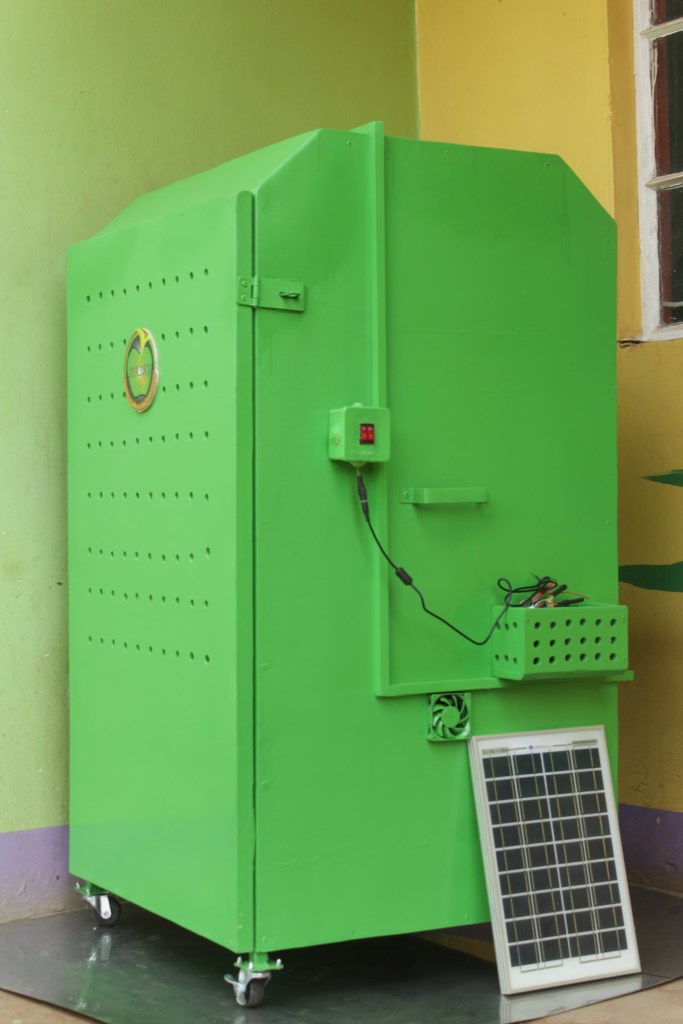
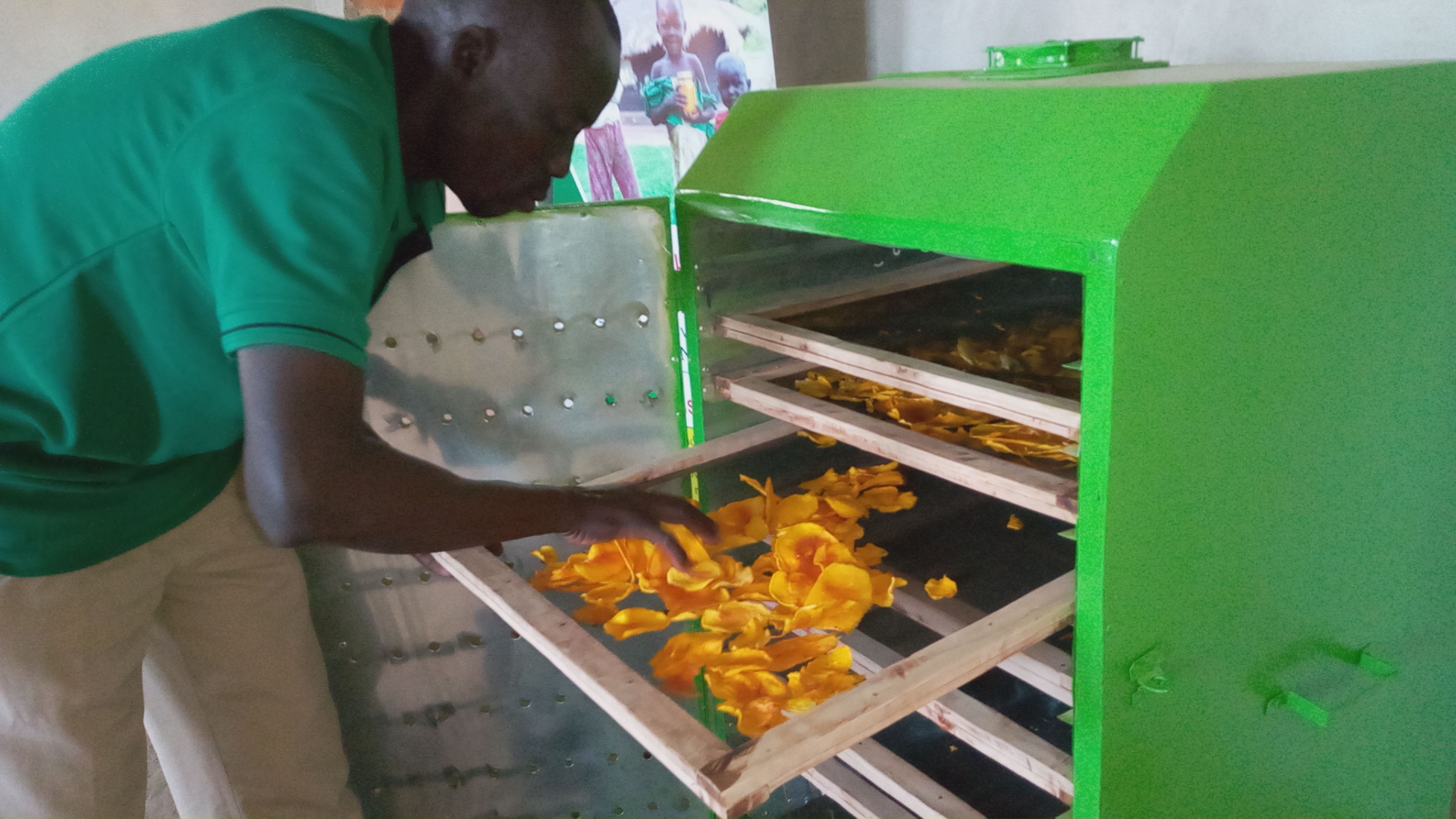
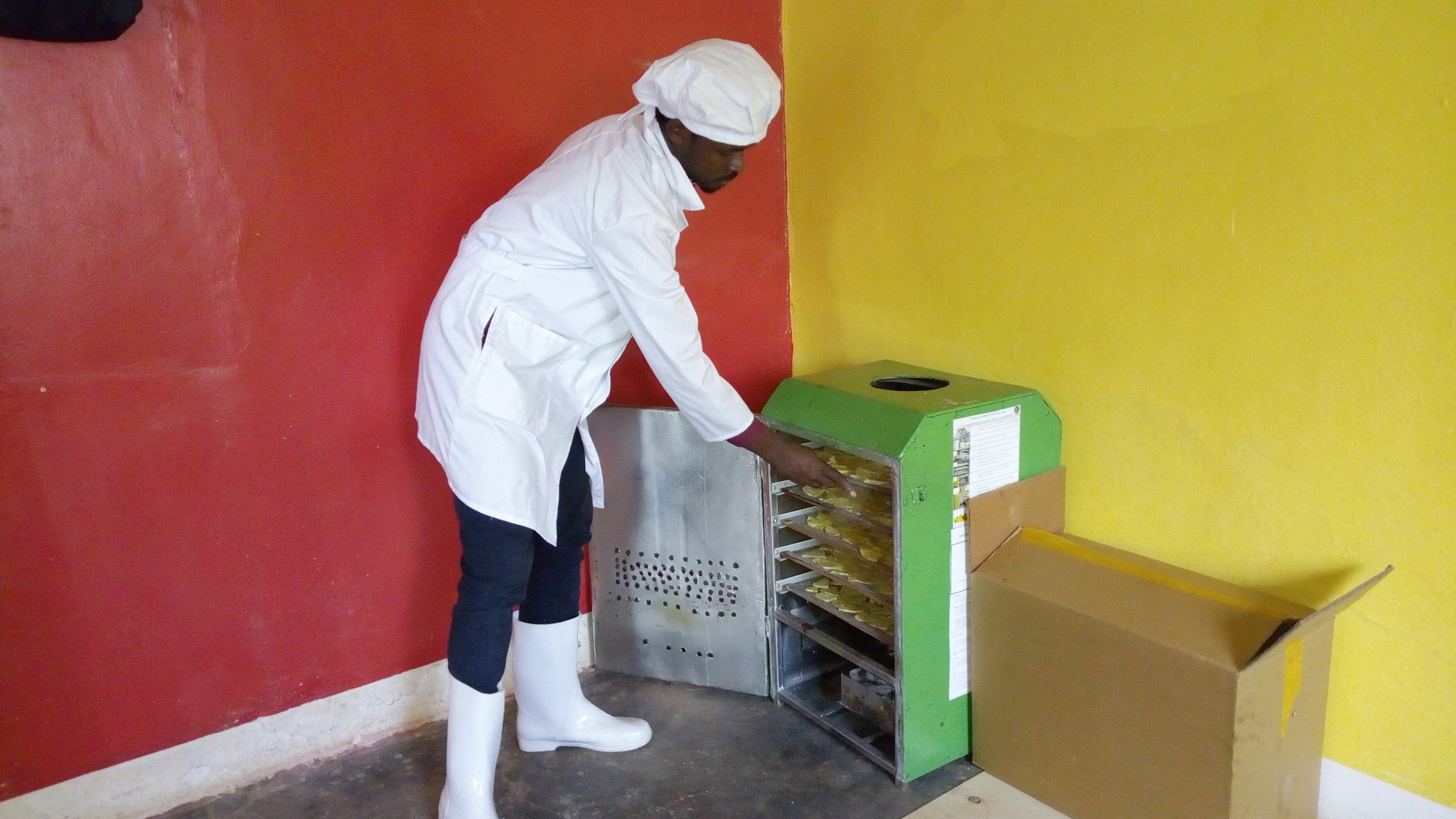
Sparky Dryer is a low-tech machine that uses biofuel to dry any choice of food stuff with the same efficiency as an electric dryer. Its source of heat makes it reliable to be used in any weather at any time, including in remote poor places without electricity.
It was designed to ensure proper food hygiene, especially during the drying process by repelling away insects and closing out soil, fungal and microbial dust found in the air. Sparky has been sold in more than seven districts in Uganda, including Kampala, Fort Portal, Jinja, Soroti, Arua, Kitgum, Wakiso, Kalangala and Luweero, impacting over 200 small-holder farmers across the country.
About eight young people are involved with the design, operation, functionality and production of the Sparky Dryer and its products in Uganda. The tech has also been extended to an international market in Rwanda, Kenya, Tanzania, Zimbabwe, Nigeria, India, Haiti and Malawi with an aim of mitigating food losses among smallholder farmers across the continent.
“For the past one year that I have used Sparky, when I calculate value addition, it has proved to me that it saves you so much by just drying the produce – although the pineapple crisps have a low market since people do not know them much and are not familiar with the product,” said Wasswa Musoke.
While speaking about the innovation, Wasswa noted that he had found the Sparky Dryer to be very efficient in terms of minimizing the post-harvest losses. He added that the machine is very easy to use, quite affordable and it takes five to six hours to dry the fruits compared to the normal food dryers that take more than 12 hours to dry food.
He also added that one way of minimizing the post-harvest losses of his pineapples has been to dry them immediately, making the dried crisps last for at least six months depending on the storage. When pineapples are freshly stored,they can only last for about two weeks, and this also depends on the way they are transported to the market.
A fresh pineapple on the Ugandan market is sold at 1,000 Ugandan shillings, while a dried one is sold at 3,000 shillings in Ugandan shops and supermarkets. This, from the agribusiness perspective, triples one’s profits.
According to Okettayot Lawrence, acting CEO of Sparky Limited Uganda, one of the biggest questions for the team as changemakers was why food was being wasted and why there wasn’t as much output as farmers like his uncle had put in.
“Seeing small-holder farmers like my uncle- in Kitgum – put in a lot of effort, and not getting quite enough from it, was one hell of a problem that we needed to address,” Okttayot said.
Sparky Dryer comes in two standard sizes, the household dryer – drying three to five kilograms of foods – costing about 850,000 Ugandan shillings, and the commercial dryer that dries five to 10 kilograms of food – costing about 1,200,000 shillings.
When farmers harvest fruits and vegetables, they are perishable and in most of Ugandan communities, most of the farmers do not have better food preservation facilities or methods for perishable fruits or vegetables.
Sparky has had a significant impact on farmers, their income and livelihood. Smallholder farmers like Wasswa have an opportunity and access to a tool that allows them to earn as much in profit from their perishable crops as other farmers who have access to expensive solar and electric dryers.

Uganda has seen increase in annual food loss along the supply chain, from production to retail level. The losses incurred on the local market are a result of inappropriate post-harvest handling and due to market surplus, particularly during peak seasons.
The concept of food loss – food that gets spilled, spoilt or otherwise lost, or incurs reduction of quality and value during its process in the food supply chain before it reaches its final product stage – occurs at the post-harvest stages, during marketing and processing.
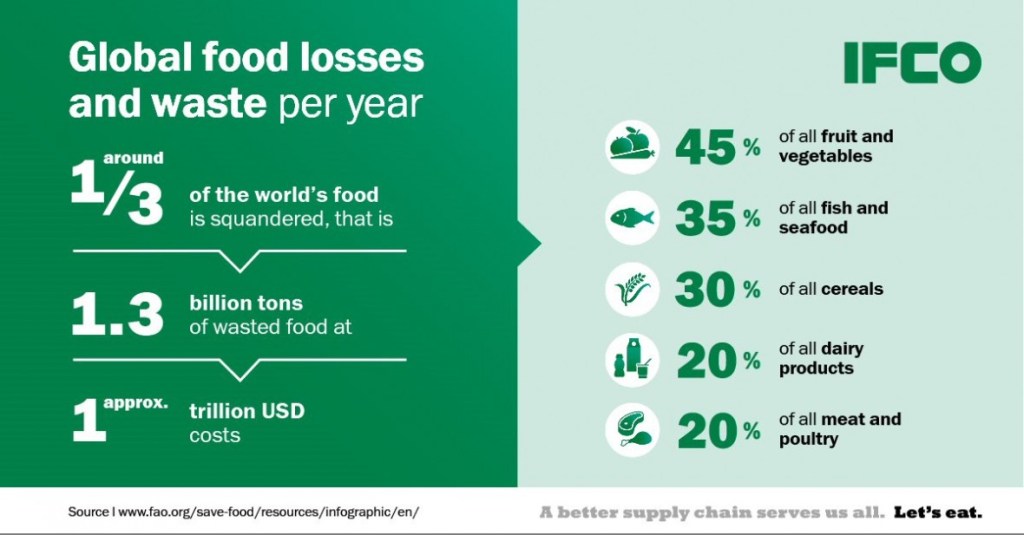
Post-harvest losses occur along the entire value chain and vary in extent depending on the produce and the region.
Uganda’s food loss percentage from 2015 to 2018, according to Uganda Bureau of Statistics,was estimated at an average of 7.7 percent, implying that 7.7 percent of the key commodities was lost along the supply chain and did not reach the retail stage.
What is the environmental impact?
The fight is familiar to many farmers, including Kikomeko Wasswa and several other farmers across the country.
“Growing up in a family that experienced a lot of food insecurity – growing a lot of food and at the end of the day – only half of what has been harvested gets to be consumed and the rest wasted; that was one hell of a problem and I needed to come up with a solution,” said Okettayot Lawrence, one of the innovators behind Sparky Food Dryer.
Isma Kaiza, Nsubuga Thomas, Okettayot Lawrence and Opiyo Morris invented a food dehydrator machine to eradicate hunger and starvation in Uganda, with the goal of reducing post-harvest losses through food preservation using the Sparky Dryer.
Besides the challenge with preservation of these fruits and vegetables, there is also a challenge of cutting down trees to get wood fuel or charcoal that would be used to preserve food. This leads to deforestation, which increases climate change. The Sparky Dryer, however, is designed to use organic waste that is readily available to farmers in all parts of the country.
In order to ensure farmers continue to use an environmentally sustainable energy source, the Sparky team trains farmers on how to use the machine and also how to make briquettes.
Waste products from harvested agricultural products are prepared and processed into briquettes, which are processed to produce the biofuel that is used to dry food.
The organically dried foods such as pineapples, jackfruit, mangoes, sweet bananas, garlic, turmeric, cayenne, ginger, and rosemary are available on both local and international markets.

Post-harvest losses occur along the entire value chain and vary in extent depending on the produce and the region.
Uganda’s food loss percentage from 2015 to 2018, according to Uganda Bureau of Statistics,was estimated at an average of 7.7 percent, implying that 7.7 percent of the key commodities was lost along the supply chain and did not reach the retail stage.
What is the environmental impact?
The fight is familiar to many farmers, including Kikomeko Wasswa and several other farmers across the country.
“Growing up in a family that experienced a lot of food insecurity – growing a lot of food and at the end of the day – only half of what has been harvested gets to be consumed and the rest wasted; that was one hell of a problem and I needed to come up with a solution,” said Okettayot Lawrence, one of the innovators behind Sparky Food Dryer.
Isma Kaiza, Nsubuga Thomas, Okettayot Lawrence and Opiyo Morris invented a food dehydrator machine to eradicate hunger and starvation in Uganda, with the goal of reducing post-harvest losses through food preservation using the Sparky Dryer.
Besides the challenge with preservation of these fruits and vegetables, there is also a challenge of cutting down trees to get wood fuel or charcoal that would be used to preserve food. This leads to deforestation, which increases climate change. The Sparky Dryer, however, is designed to use organic waste that is readily available to farmers in all parts of the country.
In order to ensure farmers continue to use an environmentally sustainable energy source, the Sparky team trains farmers on how to use the machine and also how to make briquettes.
Waste products from harvested agricultural products are prepared and processed into briquettes, which are processed to produce the biofuel that is used to dry food.
The organically dried foods such as pineapples, jackfruit, mangoes, sweet bananas, garlic, turmeric, cayenne, ginger, and rosemary are available on both local and international markets.
Although the dried fruits are enjoyed by both the young and old, Nabossa Rebecca, who holds a Bachelor of Science in in Food and Nutrition from Makerere University said that drying of fruits eliminates some nutrients that are very soluble in water. That means as one dries the fruits, they are likely to lose some of these nutrients that are good for human health.
However, Nabossa said drying of fruits also has a great advantage that it increases the shelf life of the fruit from perhaps two weeks to about six months, depending on the dehydration process and storage. Nabossa also cautioned farmers to be careful when drying, especially during open air drying in the sun that exposes the fruits to contamination and might also affect the sensory attributes of the fruits such as taste and color, making the fruit less desirable by the consumer.
The annual loss of primary forest cover and tree cover for Uganda as of 2017 was at 29,779 and in 2018 it increased to 86,461. The total tree cover loss, according to the National Forestry Authority in Uganda, indicates a 30 percent increase, which is 742,268 as of 2018.
DEFORESTATION RATES IN UGANDA FROM 2014-2018

The rapid increase of deforestation has caused a number of environmental problems such as climate change, soil degradation, reduced biodiversity, loss of recreation, loss of biological diversity and more.
In several parts of Uganda, people cut down trees as a source of fuel in the form of wood and charcoal. The fact that the biomass wood industry represents a significant economic activity implies that wood fuel will continue to be the dominant source of energy in Uganda for the foreseeable future.
This has implications on the environment and calls for other alternative sources of fuel to be taken up, such as the briquette, which has a positive effect on the environment.
According to Antonio Querido, Food and Agriculture Organization’s Representative in Uganda, food loss and waste amount to waste of resources, including water, land, energy, labour and capital. It also needlessly produces greenhouse gas emissions, which in turn contribute to global warming and climate change.
Sparky Ltd. is continuing to grow into a company that is transforming agribusiness in Uganda. The team is looking forward to establishing various drying facilities in various farming communities to increase the effectiveness of the drying process.
The team is working tirelessly to find the most effective way to export the tool. Since technology is ever changing, the team is working to improve the innovation to enable its use at the industrial level.
While addressing a media conference on the observance of the International Day of Awareness of Food Loss and Waste on 29 September 2020, at the Uganda Media Center, the Minister of Agriculture, Animal Industry and Fisheries, Vincent Bamulangaki Ssempijja noted that according to the National Development Plan III and the Uganda Bureau of Statistics, Uganda’s food loss ranges between 30 and 40 percent for grains and other staples, between 30 and 50 percent for fresh fruits and vegetables.
“The government is investing in and promoting innovative technologies and infrastructure and supporting agro-processing and value addition to reduce post-harvest losses in fruits and vegetables, by establishing logistic hubs in cluster production areas,” he said.
Since climate change is an important conversation, local and global farmers should consider environmentally friendly farming methods as they maximize profits and utilize their resources.
 Mapio
Mapio 
Leave a comment